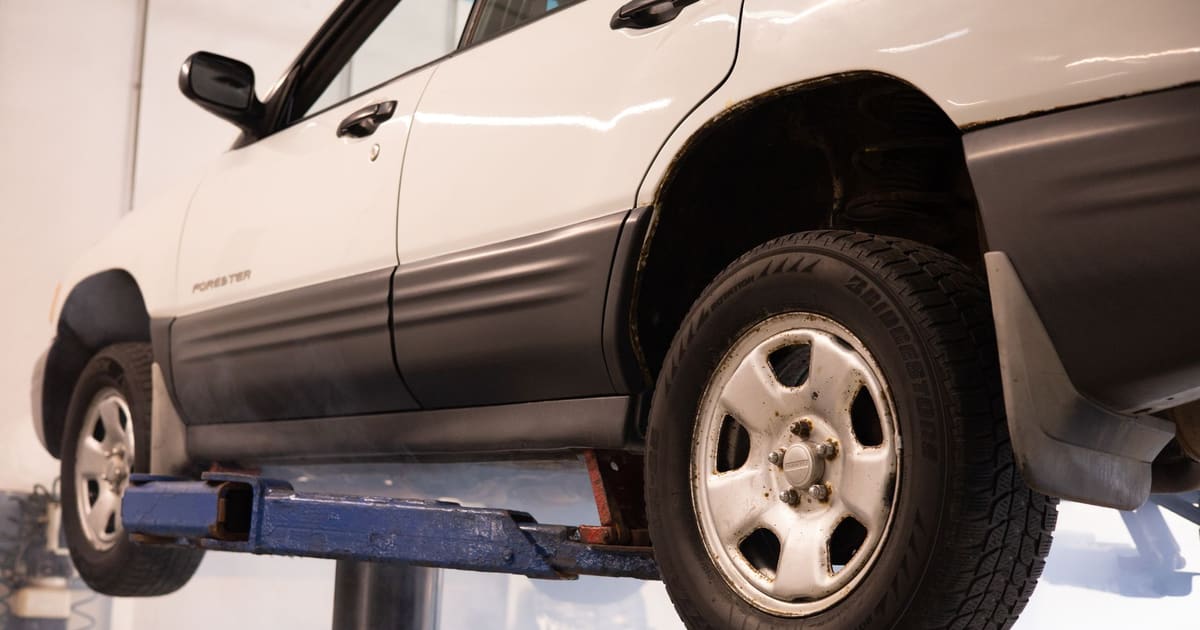
CV axle replacement typically costs $350 to $650 per axle installed at an independent shop. The job covers the constant-velocity axle shaft that transfers engine power from the transmission to the wheel. The most common warning sign is a clicking or popping noise during acceleration in tight turns -- a sound that gets louder over weeks until the joint fails completely.
What Does CV Axle Replacement Cost?
Most car owners pay $350 to $650 per axle at an independent shop, including parts and labor. Dealer pricing typically runs 20 to 30 percent higher. Parts alone range from $80 to $250 for an aftermarket replacement shaft; OEM axles cost more. Labor adds 1.5 to 3.5 hours depending on axle position and vehicle platform.
| Vehicle Type | Estimated Cost Per Axle | Notes |
|---|---|---|
| FWD economy car (Civic, Corolla, Focus) | $300 - $500 | Most accessible configuration; lower labor time |
| FWD sedan / crossover | $350 - $600 | Standard range; most common vehicle type |
| AWD SUV or truck | $450 - $750 | Rear axles add labor time; more complex shaft design |
| European AWD (Audi, BMW, Volvo) | $600 - $1,000+ | Higher parts cost; more disassembly required |
Source: Independent shop estimate data and RepairPal cost ranges by vehicle type.
If both front axles need replacement at the same visit, the incremental labor for the second axle is typically 30 to 50 percent less than the first because the surrounding components are already accessible. Ask the shop to quote both as a package if the second boot shows wear.
What Is a CV Axle and Why Do They Fail?
The constant-velocity axle is a shaft that runs from the transmission to the wheel hub, with a joint at each end that allows it to flex as the suspension moves and the wheel steers. On front-wheel-drive vehicles, these axles also transmit engine torque through the full steering range, which puts significant stress on the outer joint during tight turns.
The joints are packed with grease and sealed by a rubber boot. The boot is the system's weak point. It cracks from age, road grime, temperature cycling, and contact with road debris. Once the boot tears, grease escapes and road grit enters. The joint runs dry and the bearing surfaces pit and wear rapidly.
The outer CV joint fails most commonly because it operates at the largest angles -- it flexes through the full steering lock range every time you turn. The inner joint, which moves through smaller angles, lasts longer but can also fail, especially if the inner boot has been damaged.
Failure typically progresses in stages:
- Boot tears; grease seeps out (no noise yet, but the clock starts)
- Joint runs dry and begins to wear (faint clicking on tight turns under load)
- Wear advances (clicking audible in most turns, especially during acceleration)
- Late-stage failure (grinding, clunking, vibration at all times)
- Joint fracture or separation (loss of drive and potential vehicle control issue)
Why the Clicking Noise Gets Louder Over Time
The clicking sound is caused by the worn joint's internal components losing their precise fit. Under the combined load of engine torque and a tight steering angle, the balls and races in the joint no longer move smoothly -- they skip and grind. Each skip is a click.
As the bearing surfaces deteriorate, the noise appears at less severe angles and smaller steering inputs. What starts as a click only in a parking lot eventually becomes a clunk on normal highway on-ramps. Vibration through the steering wheel and floorboard follows as the imbalance worsens.
The timeline between first click and failure varies widely. A joint that loses grease suddenly -- from a fresh boot tear -- can fail within weeks under frequent driving. A joint that has been seeping grease for a year may take longer. There is no reliable way to predict the endpoint from the sound alone. Inspection and measurement are the only accurate tools.
Driving with a late-stage CV failure is a safety risk
A CV axle that is clicking loudly on straight roads -- not just tight turns -- has reached an advanced state of wear. At this point, axle separation under heavy acceleration is possible. Do not defer this repair once symptoms extend beyond slow parking-lot turns.
Can a Boot Replacement Extend the CV Axle?
Yes, under the right conditions. If a mechanic inspects the joint and finds it is still moving smoothly -- no roughness, no pitting on the bearing surfaces -- a boot-only replacement is a legitimate and cheaper option. The new boot keeps contamination out and allows fresh grease to do its job. This repair typically costs $150 to $250 per boot at an independent shop.
The catch: most shops replace the full axle as an assembly rather than replacing just the boot. The reason is partly economic -- a reman axle shaft is $80 to $150 in parts, and the labor to swap the shaft is similar to the labor for a boot-only job. A new shaft carries a warranty; a resealed worn joint does not.
Ask the mechanic directly: "If you pull the axle and the joint inspects clean, would you do a boot-only replacement?" A shop that gives a flat "we always replace the whole axle" without inspecting first is not necessarily wrong, but it is worth asking the question.
Signs Your CV Axle Is Failing
Recognizing the progression helps you act at the right time:
- Clicking or popping on turns: The earliest and most characteristic sign. Loud on tight turns during acceleration; may disappear during coasting.
- Vibration during acceleration: A failing inner CV joint produces a shudder or vibration that increases with throttle input and reduces at cruise.
- Grease on the inside of the wheel rim or tire sidewall: Grease escaping from a torn boot is flung onto adjacent surfaces. Check the inside of your front wheel wells periodically.
- Clunking when shifting into gear: Late-stage wear can produce a thud when transitioning from park or neutral into drive.
- Grinding or humming at all speeds: This indicates advanced joint failure or confounding wheel bearing wear. At this stage, diagnosis on a lift is essential to isolate the source. See our grinding noise diagnostic guide for how to distinguish the two.
How Long Can I Drive with a Bad CV Axle?
At the first-click stage -- audible only in parking lots during full-lock turns -- most mechanics will advise scheduling the repair within a few weeks, not a few months. The joint that is clicking will not repair itself; it will worsen at a rate that depends on driving frequency and how often you make tight turns.
At the grinding stage -- noise present on highway curves and during normal acceleration -- the repair should not be deferred. The risk of axle separation rises significantly at this point.
If you are uncertain where your vehicle is on this spectrum, a visual inspection of the boot is a reasonable first step. Grease-stained rubber or visible cracks in the boot confirm that contamination has entered and that the joint is on the clock.
How to Avoid Overpaying
Get an itemized quote. A legitimate estimate for a CV axle replacement should list: the axle part number and brand, any additional hardware (circlips, axle nut), labor hours, and the warranty on parts and labor. A quote that only says "CV axle, $550" with no line items is a starting point for questions, not an approval.
Ask about reman vs OEM. Most shops install remanufactured axle shafts, which are functionally equivalent to new for most vehicles. OEM shafts are available if you prefer original-equipment quality. The price difference is real -- ask which one the shop plans to use so you can compare quotes accurately.
Compare the labor rate. The job takes 1.5 to 2.5 hours on most front-wheel-drive vehicles. At $90 to $150 per hour, labor runs $135 to $375. If the total quote is much higher than parts-plus-labor suggests, ask for a breakdown. Our guide to reading a repair estimate shows you exactly what to look at line by line.
Ask about the other side. If one boot is torn, the other may be cracked. An inspection of both axles during the same visit adds no labor cost and gives you accurate information about whether you should plan for a second repair soon.
Use the repair cost estimator to benchmark quotes before you call
Before calling shops, use our repair cost estimator to see the typical range for your vehicle type. Walking in with a number in your head puts you in a better position to evaluate whether the first quote you receive is reasonable or a starting point for negotiation.
Frequently asked questions
How much does a CV axle replacement cost?
CV axle replacement typically costs $350 to $650 per axle at an independent shop, including parts and labor. The range shifts by vehicle: front-wheel-drive economy cars tend toward the lower end; all-wheel-drive trucks and SUVs trend higher because the axle is more complex. Rear axles on AWD vehicles add labor time, pushing costs toward the top of the range.
What causes a clicking noise when turning?
A clicking noise on tight turns during acceleration almost always points to a worn outer CV joint. The joint transfers engine power to the wheel through a range of suspension angles. When the rubber boot protecting the joint tears, grease escapes and grit contaminates the bearing surfaces. The clicking is the worn joint loaded under the combined stress of power delivery and tight steering angle.
Is it safe to drive with a bad CV joint?
A clicking CV joint can be driven short distances at first, but the joint degrades rapidly once the boot has failed. In advanced failure the joint can seize in a turn or fracture under acceleration load. Driving at highway speed with a severely worn CV axle carries a real risk of axle separation. Most mechanics advise replacement within a few weeks of the first symptoms, not months.
Should I replace both CV axles at the same time?
Not necessarily. Unlike brake pads or rotors, CV axles do not degrade symmetrically. Replace the axle that is failing. However, if your vehicle has high mileage and the boots on the other axle show cracks or grease seepage, replacing both during the same labor visit saves money because the labor to access the second axle is minimal once the first is already out.
Can just the CV boot be replaced to save money?
Yes, if the joint itself is still in good condition. A boot-only replacement costs $150 to $250 at most shops and stops further contamination. However, if grease has already escaped and the joint has been running dry, the bearing surfaces are likely already pitted. In that case, a boot-only repair buys a short time before the joint fails anyway. Ask the mechanic to inspect the joint before recommending boot-only vs full axle.
How long does a CV axle replacement take?
Most CV axle replacements take 1.5 to 2.5 hours of labor for a front axle on a front-wheel-drive vehicle. Rear axles on AWD platforms take longer, often 2 to 3.5 hours, because of additional disassembly. At typical independent shop labor rates of $90 to $150 per hour, labor alone runs $135 to $525 depending on the vehicle and axle position.