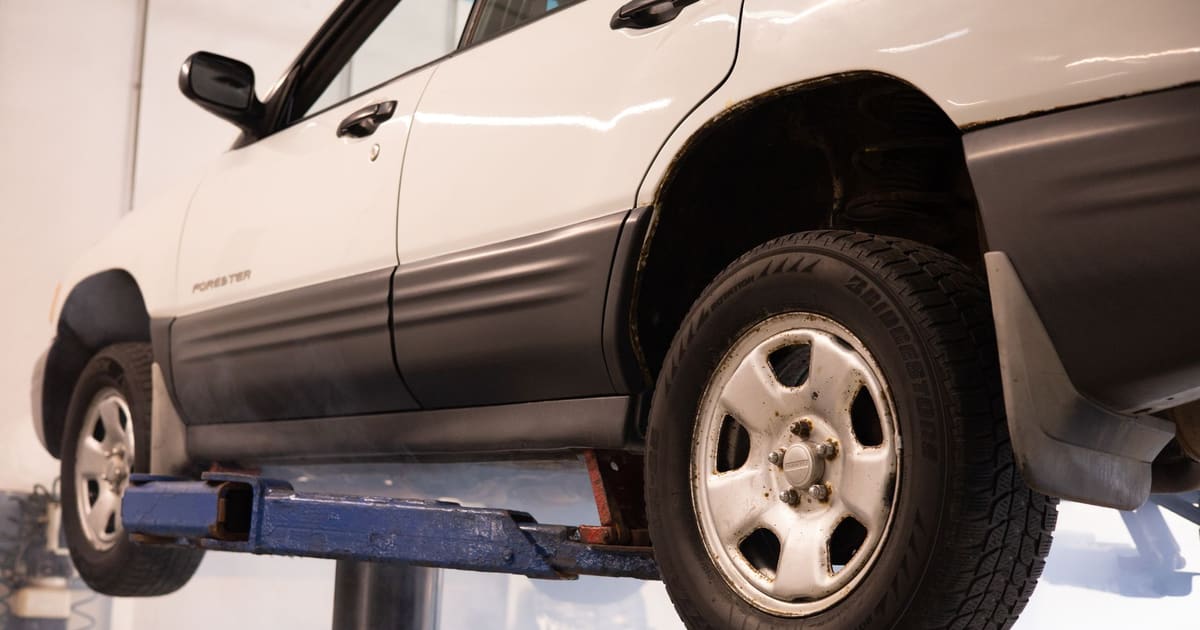
Replacing a pair of struts or shocks typically costs $500 to $1,000 in parts and labor at an independent shop, according to RepairPal's national repair cost data. A full four-corner replacement - all four struts or all four shocks - typically runs $1,000 to $2,000 before an alignment. The alignment is not optional after front strut work; plan for it in your budget from the start.
What Do Struts and Shocks Replacement Cost?
RepairPal places the national range at $500 to $1,000 for a pair of front struts at an independent shop, or $400 to $800 for a pair of rear shocks on vehicles that use separate shock absorbers. Full four-corner replacement runs $1,000 to $2,000. Adding a wheel alignment - required after any front strut replacement and generally recommended after rear strut work - adds $80 to $120 to the total.
| Service Scope | Typical Total Cost | What Is Included |
|---|---|---|
| Front struts only (pair) | $500 - $1,000 | Two strut assemblies or bare struts, springs, top mounts; alignment required |
| Rear shocks only (pair) | $350 - $700 | Two shock absorbers; alignment typically not required |
| Rear struts only (pair) | $400 - $800 | Two strut assemblies; rear alignment recommended |
| Full four-corner replacement | $1,000 - $2,000 | All four corners; full alignment required |
| Alignment (post-strut) | $80 - $120 | Four-wheel alignment; separate line item |
Source: RepairPal national repair cost estimates. Ranges reflect spread across vehicle types, parts grades, and regional labor rates. Luxury and performance vehicles often exceed these figures.
Struts vs Shocks: What Is the Difference and Why It Affects Price?
A strut is a structural suspension component. It combines a shock absorber, a coil spring mount, and a load-bearing pivot into one assembly. On vehicles with strut front suspensions - most front-wheel-drive cars and crossovers - the front struts are part of the steering and load-bearing system. Replacing them requires supporting the vehicle, unloading the spring, and reinstalling with precision torque and alignment afterward.
A shock absorber on a vehicle with a separate spring design (common on rear suspensions, trucks, and some older rear-wheel-drive cars) is simpler to replace. It bolts in and out without the spring compression step and often without alignment afterward.
The design difference explains the cost difference: strut replacement is more labor-intensive, takes longer, requires more setup, and always triggers an alignment need. Shock-only replacement is typically a shorter job with less follow-on cost.
Quick-strut assemblies - pre-assembled units that include the strut, spring, and top mount together - cost more in parts but save labor time because spring compression and mount hardware installation are done at the factory. Shops often prefer quick-strut assemblies on high-volume jobs because the savings in labor time offset the higher parts cost, and you get new spring perches and top mount bearings as part of the replacement.
Replace One or All Four? What Shops Recommend
The standard recommendation from most ASE-certified mechanics aligns with what RepairPal and Monroe both publish: replace in matched pairs at minimum - both fronts or both rears - because mismatched wear levels between sides creates uneven handling and cornering behavior.
Whether to replace all four at once depends on current condition and mileage. If the fronts are failing at 70,000 miles and the rears are in similar condition, doing all four in one visit saves money compared to two separate visits - you pay for alignment and labor setup once instead of twice. If the rears were replaced recently and are in good condition, only replacing the fronts is reasonable.
Ask the mechanic to assess all four corners during any strut service visit and give you measurements or a condition rating for each. A competent shop will do this as part of a suspension inspection without billing extra for it.
Parts vs Labor Breakdown
Industry labor-rate surveys and flat-rate labor guides place front strut replacement at 2 to 3 hours per pair on most vehicles. At an independent shop billing $100 per hour, that is $200 to $300 in labor. At $140 per hour, it is $280 to $420. Parts for a quality front strut pair - branded assemblies from KYB, Monroe, or Bilstein - range from $150 to $400 depending on vehicle. Quick-strut assemblies are $250 to $500 per pair.
The alignment adds $80 to $120 and takes another 30 to 45 minutes of time on the alignment rack.
On a mid-range vehicle with a straightforward front strut design, you should expect: $150 to $300 in parts, $200 to $300 in labor, and $80 to $100 for alignment, totaling $430 to $700 at a competitive independent shop. If a quote is significantly above or below this breakdown, ask for the itemized estimate to understand where the difference lies.
Ask the shop which brand of strut they plan to install
Monroe, KYB, Gabriel, and Bilstein are the major strut brands. Monroe and KYB are the most widely stocked and are considered the baseline for quality aftermarket replacement. Bilstein is a premium option used by shops specializing in performance and European vehicles. Ask specifically - if a shop plans to install a no-name economy strut, that is worth knowing before you approve the work, because ride quality and durability differ meaningfully between brands.
Why You Need an Alignment After Strut Replacement
Wheel alignment is the adjustment of the angles at which your tires contact the road. The key angles are camber (tilt in or out), caster (forward or backward lean of the steering axis), and toe (pointing in or out).
Struts are a load-bearing part of the front suspension geometry. When worn struts are replaced with new ones - or when the mounting hardware is disturbed during replacement - the angles at which the wheel sits relative to the road change. New struts installed without a subsequent alignment mean your wheels are almost certainly not at the manufacturer's specified angles.
Driving on out-of-spec alignment after strut replacement causes uneven tire wear on the freshly balanced and possibly new tires you just put on the car, reduced fuel economy from rolling resistance, and handling that does not match what the car's steering geometry was designed for.
The $80 to $120 alignment fee is not a shop upsell - it is a necessary completion step for front strut work. The rare exception is rear shock absorber replacement on a vehicle that does not have adjustable rear alignment - confirm with the shop whether rear alignment is possible on your vehicle.
Signs Your Shocks or Struts Need Replacing
Bouncing or floating after bumps. Test this by pushing down firmly on each corner of the car and releasing. The corner should rise and settle with one or two bounces maximum. If it continues bouncing, the shock or strut is not controlling the spring rebound effectively.
Vehicle body roll in corners. Significant lean in turns indicates reduced damping. This affects both comfort and safety, particularly during emergency maneuvers.
Nose-dive during braking. When braking, the front of the car should dip slightly and recover quickly. Excessive nose-dive, or slow recovery, indicates front strut wear.
Cupped or uneven tire wear. Worn shocks cause the tire to bounce on the road surface rather than maintain consistent contact. This produces a scalloped or cupped wear pattern around the tire's circumference. If you see this pattern, tire replacement without also addressing the shocks will just repeat the damage. Read our tire replacement cost guide for what to expect when replacing tires in conjunction with suspension work.
Oil streaks on the strut body. Struts contain hydraulic oil. When the seals wear, oil seeps along the strut body and leaves a visible streak. This is not always present on worn struts, but its presence is a clear indicator that the unit needs replacement.
How to Avoid Overpaying
Use RepairPal's estimator for your specific vehicle. Strut costs vary significantly by make and model - the job on a 2016 Honda CR-V is priced differently from a 2016 Audi Q5. The estimator accounts for vehicle-specific parts cost and labor time.
Get two written, itemized estimates. A legitimate quote breaks out: strut brand and part numbers, spring and top mount hardware if doing full assembly, labor hours, and alignment fee as a separate line. Avoid shops that quote "strut service" as a single lump sum. Our guide to reading a repair estimate covers exactly what to look for in each line item.
Dealer vs independent shop. Dealers typically use OEM or OEM-spec parts and bill at higher labor rates, which raises the total cost 20 to 30 percent over independent shops on average. For suspension work on a non-warranty vehicle, an independent shop staffed by ASE-certified technicians is typically the better value. See our dealer vs independent shop guide for a full comparison of when each option makes more sense.
Understand what is and is not required. Not every strut replacement requires replacing the coil spring, top mount, and bearing separately if the car is getting a quick-strut assembly (all components included). If a shop is billing parts for a quick-strut assembly AND separately for a spring, mount, and bearing, confirm that those parts are actually needed beyond the assembly. Ask for the rationale on each line.
Check whether additional repairs are legitimate add-ons. Strut replacement sometimes surfaces related issues: worn sway bar links (often $100 to $200 per pair), degraded control arm bushings, or a damaged wheel bearing that was masked by strut noise. These can be legitimate findings. Ask the mechanic to show you or photograph any components they recommend replacing beyond the struts, and confirm the defect is documentable. See our wheel bearing replacement cost guide for what to expect if that is also in play.
Worn struts affect stopping distance, not just ride comfort
The safety consequence of severely worn struts is often underestimated. Data from Monroe's consumer education materials shows stopping distance can increase measurably on vehicles with degraded dampers compared to new ones, because consistent tire-to-road contact is reduced during hard braking. A car with worn struts that needs new tires due to cupped wear has two compounding problems affecting safety. Ride comfort is the first symptom you notice; braking and handling are the reasons it matters.
Frequently asked questions
How much does it cost to replace struts and shocks?
Replacing a pair of struts typically costs $500 to $1,000 in parts and labor, according to RepairPal. A full four-corner replacement runs $1,000 to $2,000 at most independent shops. Shocks-only replacement (vehicles with separate shock absorbers, not struts) is often slightly less because the components are simpler. An alignment following strut replacement adds $80 to $120 to the total.
Should I replace struts in pairs or all four at once?
Replacing in pairs -- both fronts or both rears together -- is standard because matching ride quality side to side produces predictable handling. A worn strut on one side and a new one on the other creates uneven cornering and braking. Replacing all four at once is cost-efficient when all four are at similar mileage, since labor setup cost is mostly fixed and a shop can complete four corners for less than two separate visits.
What is the difference between a strut and a shock absorber?
A strut is a structural component that serves as both a shock absorber and a load-bearing part of the suspension. It holds the wheel in alignment and supports vehicle weight. A shock absorber (used on vehicles with separate spring and shock design) only damps suspension movement and does not carry structural load. Most modern front-wheel-drive vehicles use struts at the front; the rear suspension may use struts or separate shocks depending on design.
Do I need an alignment after replacing struts?
Yes, for front strut replacement. Struts are a structural part of the front suspension geometry. Removing and reinstalling them - or installing new ones with slightly different geometry than worn originals - changes caster and camber angles. Skipping the alignment after strut replacement means you may be driving a car with incorrect wheel angles, which accelerates tire wear and affects handling. The alignment adds $80 to $120 to the total and is not optional.
How long do shocks and struts last?
Most shocks and struts last 50,000 to 100,000 miles, according to RepairPal. The wide range reflects driving conditions: city driving with frequent stops and starts, poor road surfaces, and carrying heavy loads accelerate wear. Monroe and KYB both publish wear guides noting that by 50,000 miles many components show measurable decline in damping performance even if no dramatic failure has occurred. A bounce test and visual inspection can help assess current condition.
Can worn struts affect my brakes or steering?
Yes. Worn struts increase stopping distance because they reduce the tire's ability to maintain consistent road contact during hard braking. Braking distance can increase by 10 to 20 percent on severely worn struts compared to new ones, according to data published by Monroe. Worn struts also reduce steering precision and can cause body roll and instability during lane changes, particularly at highway speeds.